
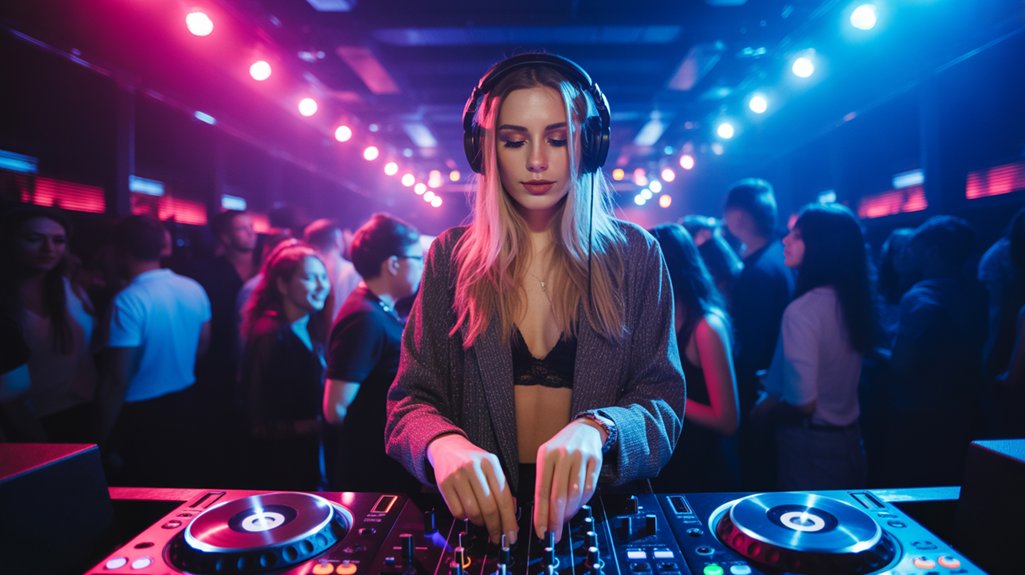
When a girl plays DJ, she actively transforms from passive music consumer to creative curator, expressing her musical identity while demonstrating technical expertise in traditionally male-dominated spaces. This role allows her to control social atmospheres, build confidence through artistic expression, and establish deeper connections with audiences through carefully selected soundscapes. Her playlist choices reveal personality traits, cultural awareness, and emotional intelligence, while challenging gender assumptions about musical knowledge and equipment mastery. Understanding these motivations reveals the complex psychology behind this creative pursuit.
She’s Expressing Her Musical Identity and Taste
When a girl takes control of the music selection at a party, in a car, or during a casual hangout, she’s often revealing intimate aspects of her personality and cultural identity through carefully curated soundscapes. Music psychologist Dr. Daniel Levitin explains that playlist creation serves as “an extension of one’s inner emotional landscape,” allowing individuals to communicate values, experiences, and aspirations without verbal expression. Through her musical influences, she showcases formative artists who shaped her worldview, while genre exploration demonstrates intellectual curiosity and cultural awareness. Whether shifting from indie folk to electronic dance music or weaving together hip-hop with classic rock, her selections create a sonic autobiography that invites others into her personal narrative, fostering deeper connections through shared musical discovery.
Taking Control of the Social Atmosphere
Beyond personal expression, a girl who assumes the role of DJ strategically orchestrates the emotional tenor and energy flow of any gathering, wielding music as a powerful tool for social influence. This musical leadership transforms her from passive participant to active architect of collective experience, determining whether conversations flourish during mellow tracks or bodies move during high-energy selections.
Research in environmental psychology demonstrates that music greatly impacts group dynamics and social cohesion. When a girl controls the playlist, she fundamentally becomes the evening’s emotional conductor, reading the room’s energy and responding with appropriate sonic choices. This social influence extends beyond entertainment, creating moments of shared experience that bond attendees together. Her musical selections can elevate mundane gatherings into memorable occasions, establishing her as a cultural curator within her social circle.
Building Confidence Through Creative Expression
For many young women, DJing becomes a powerful vehicle for creative self-expression, allowing them to communicate their musical identity while simultaneously building personal confidence through performance. The process of curating sets and reading crowd responses helps female DJs develop their unique artistic voice, transforming personal music tastes into public statements that reflect their cultural perspectives and aesthetic choices. Research indicates that creative performance activities, particularly in male-dominated fields like electronic music, can greatly reduce performance anxiety while fostering leadership skills and self-assurance among female participants.
Finding Your Musical Voice
Three distinct phases typically emerge as female DJs discover their unique artistic identity, transforming from tentative beat-matching attempts into confident sonic storytelling.
Phase One: Musical Exploration****
Initial experimentation involves sampling diverse genres, from underground techno to mainstream pop, allowing emerging artists to identify resonant sounds. This musical exploration period creates foundational knowledge while revealing personal preferences and natural mixing tendencies.
Phase Two: Technical Mastery****
Developing proficiency with equipment and software enables more sophisticated creative choices. Female DJs often gravitate toward innovative techniques, incorporating live instruments or vocal elements that distinguish their performances from traditional approaches.
Phase Three: Personal Empowerment****
The final stage represents authentic self-expression through curated musical narratives. Research indicates that women DJs frequently develop signature styles emphasizing emotional connectivity over aggressive energy, creating intimate dancefloor experiences that reflect their unique perspectives and life experiences.
Overcoming Performance Anxiety
The vulnerability inherent in live performance creates a paradox where female DJs must simultaneously expose their artistic vision while commanding authority in male-dominated venues. This psychological tension amplifies traditional stage fright, requiring specialized performance strategies that address both technical skills and confidence building.
Effective anxiety management begins with thorough preparation, allowing muscle memory to compensate when nerves spike during live sets. Many successful female DJs develop pre-performance rituals, from meditation to equipment checks, that create psychological anchors. Research shows that reframing anxiety as excitement can transform nervous energy into creative fuel.
Progressive exposure therapy, starting with smaller venues before advancing to larger crowds, builds resilience gradually. Recording practice sessions helps identify strengths while revealing areas needing improvement, fostering realistic self-assessment that combats imposter syndrome frequently experienced by women entering technical fields.
Testing Her Skills and Seeking Validation
Many girls gravitate toward controlling the music as a way to showcase their musical knowledge and gauge reactions from their audience. This behavior represents a form of skill assessment, where the DJ role becomes a testing ground for musical taste and technical abilities. According to music psychology research, individuals often use curated playlists as validation techniques to establish social credibility and demonstrate cultural awareness.
The act of DJing allows for real-time feedback collection, as girls observe crowd responses, dancing patterns, and verbal reactions to their song choices. This immediate validation loop helps build confidence while revealing areas for improvement. Music therapist Dr. Sarah Chen notes that “controlling the soundtrack creates a sense of agency and artistic expression.” The DJ booth transforms into a laboratory where musical instincts meet social dynamics, providing valuable insights into both personal preferences and audience psychology.
Making a Statement About Gender Roles in Music
Beyond personal validation, female DJs often use their platform to challenge long-standing assumptions about women’s roles in music production and electronic entertainment. This musical empowerment serves as a powerful statement against industry stereotypes that have historically marginalized women’s contributions to electronic music culture.
| Traditional Expectation | Female DJ Reality | Impact on Industry |
|---|---|---|
| Women as passive consumers | Active music creators | Increased gender representation |
| Technical skills as masculine | Mastery of complex equipment | Skill-based credibility |
| Entertainment as secondary | Headlining major events | Leadership visibility |
| Limited genre participation | Cross-genre innovation | Creative expansion |
| Support role emphasis | Independent artistic vision | Autonomous expression |
Research indicates that women who embrace DJing often view their participation as activism, deliberately occupying spaces traditionally dominated by men while demonstrating equal technical competency and creative vision.
Reading the Room and Adapting to the Crowd
How does a skilled female DJ transform a lackluster gathering into an electrifying experience that keeps people moving until closing time? The answer lies in her ability to read crowd dynamics and adapt accordingly. Expert DJs observe subtle cues like body language, energy levels, and audience engagement to gauge the room’s pulse. According to music psychologist Dr. Sarah Chen, “Successful DJs function as emotional barometers, constantly adjusting their musical selections to match and elevate crowd energy.” This intuitive understanding allows female DJs to craft a musical atmosphere that resonates with their audience. They seamlessly shift between genres, tempos, and moods, responding to real-time feedback. Whether shifting from mellow background music to high-energy dance tracks, these artists demonstrate sophisticated crowd management skills that extend far beyond technical mixing abilities.
Using Music as a Form of Social Connection
When a girl takes control of the music selection, she often transforms the listening experience into a powerful tool for building connections with others around her. Music psychologist Dr. Daniel Levitin notes that shared musical experiences activate the brain’s social bonding mechanisms, creating what researchers call “musical empathy” between listeners who synchronize to the same rhythms and melodies. Through collaborative playlist creation and encouraging group participation in dancing, she establishes a communal atmosphere where individual musical preferences merge into collective enjoyment, strengthening social ties through the universal language of sound.
Building Musical Bonds Together
Music serves as one of humanity’s most powerful bonding mechanisms, creating invisible threads that connect people across cultural, generational, and social boundaries. When girls assume the DJ role, they transform passive listening into active musical storytelling, weaving narratives through carefully curated song selections that reveal personal experiences, emotions, and cultural influences.
This collaborative creativity extends beyond individual expression, fostering deeper connections through shared musical discovery. Research indicates that synchronized musical experiences release oxytocin, strengthening social bonds between participants.
| Musical Bond Type | Connection Method |
|---|---|
| Emotional Sharing | Vulnerable song choices |
| Memory Creation | Soundtrack moments |
| Cultural Exchange | Diverse genre exploration |
| Intimate Communication | Nonverbal musical dialogue |
Through DJ activities, participants develop enhanced empathy, cultural awareness, and communication skills that transcend traditional conversation barriers.
Shared Playlist Creation
Digital platforms have revolutionized the collaborative musical experience, enabling shared playlist creation that extends the DJ’s influence beyond physical gatherings into virtual communities. When girls engage in playlist collaboration, they’re fundamentally curating emotional landscapes that reflect their identity and forge deeper connections with others.
Research indicates that sharing musical preferences serves as a form of social bonding, allowing individuals to communicate aspects of their personality that might be difficult to express through words alone. Dr. Sarah Thompson, a social psychologist at Berkeley, notes that “collaborative playlists function as modern mixtapes, creating intimate spaces for emotional exchange.”
Through platforms like Spotify and Apple Music, shared playlists become living documents of relationships, evolving as contributors add songs that reflect their moods, memories, and aspirations together.
Dancing Creates Community
Through the rhythmic movement of bodies synchronized to beats, girls who take on DJ roles transform individual musical expression into collective experiences that build lasting social bonds. These dance events become catalysts for community vibes, where strangers unite through shared experiences and mutual enjoyment of music.
| Community Building Elements | Observable Outcomes |
|---|---|
| Musical interaction patterns | Enhanced group cohesion |
| Collaborative experiences | Stronger friendships |
| Dance rituals emergence | Cultural identity formation |
| Common interests alignment | Sustained social networks |
Research indicates that social gatherings centered around music create powerful psychological connections. When girls orchestrate group activities through DJing, they facilitate environments where participants develop meaningful relationships beyond the dance floor, establishing communities rooted in shared musical appreciation and collective movement experiences.
Demonstrating Technical Knowledge and Passion
Behind the turntables, a female DJ’s meticulous beatmatching and seamless alterations serve as powerful displays of technical mastery that challenge traditional gender assumptions about musical expertise. When women demonstrate sophisticated technical skills, they actively dismantle stereotypes suggesting electronic music production requires inherently masculine abilities. Research from Dr. Sarah Raine at the University of Westminster reveals that female DJs often face heightened scrutiny regarding their music knowledge, requiring them to prove their competence more extensively than male counterparts. This pressure transforms performances into educational opportunities, where women showcase deep understanding of sound engineering, harmonic mixing, and equipment operation. Through precise track selection and flawless shifts, female DJs communicate passion while establishing credibility within traditionally male-dominated spaces, ultimately expanding perceptions of who belongs behind the decks.
Establishing Her Position Within the Group Dynamic
When a woman assumes control of the music at a social gathering, she strategically positions herself as the cultural curator who shapes the evening’s emotional trajectory and social interactions. This deliberate action establishes her influence within peer dynamics, creating a subtle but powerful form of social authority that extends beyond simple song selection.

 Personality Spark