
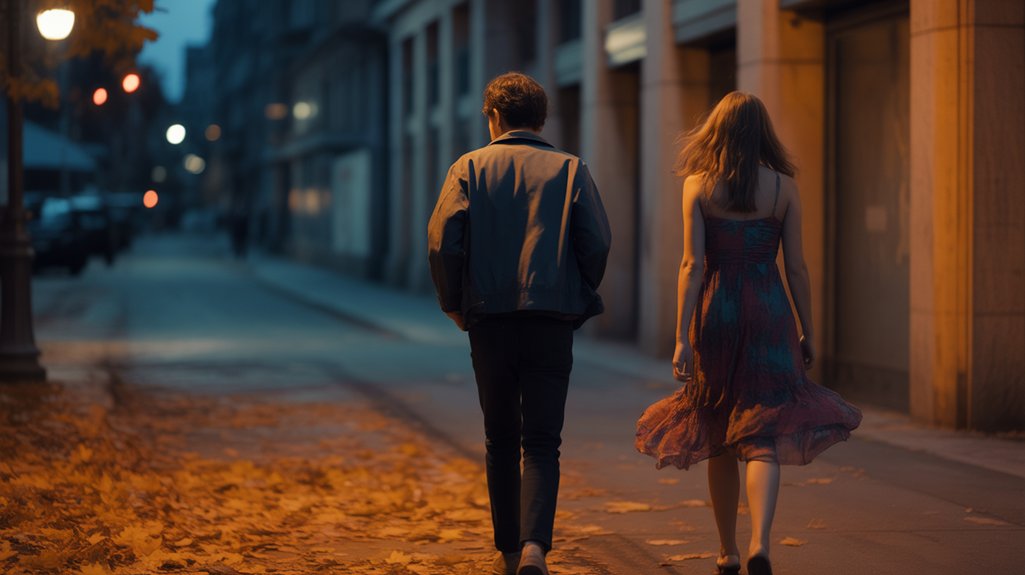
When a man walks behind a woman, this behavior typically stems from respect for personal boundaries, protective instincts, cultural conditioning, or uncertainty about appropriate social distance. Walking behind demonstrates consideration for her comfort level and autonomy, allowing her to set the pace and direction. It may reflect evolutionary guardian instincts, social programming about masculinity, or nervousness about relationship dynamics. However, repeated unwanted following could indicate stalking concerns. Understanding the context and accompanying body language reveals deeper motivations behind this common social positioning.
He’s Being Respectful and Giving You Space
When a man chooses to walk behind a woman, it often reflects his conscious effort to respect her personal boundaries and demonstrate considerate behavior. This positioning allows the woman to set the pace, choose the direction, and maintain control over her immediate environment. According to relationship experts, maintaining a respectful distance while walking demonstrates emotional intelligence and social awareness. The man acknowledges that crowding someone’s personal space can create discomfort, particularly in unfamiliar settings or during early stages of acquaintance. This behavior often indicates genuine consideration for the woman’s comfort level and autonomy. By walking behind rather than beside or ahead, he communicates that he values her independence and doesn’t wish to appear pushy or overly assertive in the interaction.
Cultural or Social Conditioning Influences His Behavior
Although personal choice plays a significant role in walking behavior, deeply ingrained cultural and social conditioning often shapes how men position themselves relative to women in public spaces. Many societies have historically established cultural expectations that men should protect women, leading some men to walk behind as a form of vigilant guardianship. Traditional social norms in various cultures dictate that men demonstrate deference by allowing women to lead, particularly in formal or public settings. According to anthropologist Dr. Helen Fisher, “Cultural programming runs deeper than conscious thought, influencing our spatial relationships without awareness.” Some men unconsciously adopt protective positioning due to societal messages about masculinity and responsibility. These learned behaviors often persist even when individuals haven’t consciously considered their walking patterns or underlying motivations.
He’s Uncertain About Walking Beside You
Sometimes a man’s decision to walk behind stems from genuine uncertainty about the appropriate social distance or positioning within the relationship dynamic. This hesitation often reflects deeper insecurities about his role, whether he’s unsure of matching her walking pace, lacks confidence in the relationship’s boundaries, or feels uncertain about asserting himself in shared spaces. According to relationship psychologist Dr. John Gottman, such behavioral uncertainty frequently indicates an individual’s struggle to calibrate their level of intimacy and personal space within evolving social connections.
Lacks Relationship Confidence
Hesitation creeps into a man’s behavior when he feels uncertain about his place in a relationship, often manifesting as a reluctance to walk alongside his partner. This relationship hesitation frequently stems from deeper self esteem issues that create distance, both physical and emotional. When men doubt their worthiness or fear rejection, they unconsciously position themselves as followers rather than equals.
- Questioning whether he deserves to be seen as her partner in public
- Worrying that walking together might seem presumptuous or forward
- Feeling intimidated by her confidence, success, or social status
- Experiencing anxiety about others judging their relationship dynamics
- Struggling with past romantic failures that influence current behavior patterns
This positioning reflects internal uncertainty about relationship security, where physical distance becomes a protective mechanism against potential emotional vulnerability.
Unsure About Your Pace
Physical coordination becomes a delicate dance when men struggle to match their partner’s walking rhythm, creating an awkward choreography that keeps them trailing behind. Different walking habits create genuine logistical challenges that many couples overlook. Height differences, stride lengths, and preferred speeds can transform simple strolls into complicated negotiations.
Some men hang back because they’re genuinely uncertain about maintaining comfortable personal space while walking together. They worry about stepping on feet, bumping shoulders, or creating an uncomfortable closeness that feels forced. This hesitation often stems from overthinking rather than disinterest.
According to relationship researcher Dr. Helen Fisher, “Physical synchronization in walking reflects deeper emotional attunement between partners.” Men who lag behind may simply need time to develop this natural rhythm, preferring cautious distance over potentially awkward physical coordination.
Testing Social Boundaries
When men deliberately position themselves behind their walking companions, they often engage in a subtle form of social experimentation, testing the boundaries of acceptable proximity and interaction. This behavior represents an exploration of social dynamics, where they gauge comfort levels through nonverbal cues rather than direct communication.
Men testing social boundaries through walking etiquette may exhibit these patterns:
- Gradually adjusting their distance to observe reactions and establish relationship standards
- Monitoring body language for signs of discomfort regarding personal space
- Using walking position as a low-risk method to assess social interactions
- Observing whether companions slow down, look back, or create more distance
- Evaluating the appropriateness of closer proximity based on contextual social dynamics
This boundary testing allows men to navigate complex social interactions while minimizing potential awkwardness or rejection.
He’s Trying to Protect or Watch Over You
When a man positions himself behind a woman while walking, he may be adopting a protective stance that reflects deep-seated evolutionary instincts to safeguard those he cares about. This behavior often manifests through systematic scanning for potential threats, strategic positioning to create a physical safety barrier, and heightened awareness of environmental factors that could pose risks. According to behavioral psychologist Dr. Helen Fisher, this protective positioning allows men to “maintain visual surveillance of both the person they’re with and the surrounding environment, fulfilling an instinctual guardian role.”
Scanning for Potential Threats
A protective instinct often drives men to position themselves strategically behind women, allowing them to maintain visual surveillance of their surroundings while keeping their companion within their protective sphere. This positioning enables thorough threat evaluation, as research indicates men frequently scan environments for potential dangers when accompanying someone they care about. Walking behind provides an ideal vantage point for monitoring approaching individuals, identifying suspicious behavior, and evaluating escape routes if necessary.
Key behaviors include:
- Constantly checking over shoulders and scanning crowds
- Positioning themselves between their companion and potential threats
- Maintaining heightened awareness in unfamiliar or crowded environments
- Adjusting walking pace to monitor surrounding activity
- Creating physical barriers with their body when sensing danger
This personal security mindset reflects evolutionary protective instincts that remain prevalent in modern dating and relationship dynamics.
Creating Physical Safety Barrier
Men instinctively position their bodies as human shields, transforming themselves into living barriers between their companion and perceived dangers in the environment. This protective positioning demonstrates evolutionary programming that prioritizes personal safety through strategic physical distance management.
When a man walks behind a woman, he creates a defensive perimeter that allows him to monitor approaching threats while maintaining ideal reaction positioning. This behavior reflects deeply ingrained protective instincts that emerge naturally in potentially vulnerable situations.
| Protective Behavior | Safety Function |
|---|---|
| Positioning behind | Creates reaction buffer |
| Scanning surroundings | Identifies potential risks |
| Adjusting walking pace | Maintains protective distance |
| Ready body posture | Enables quick intervention |
Research indicates this positioning allows men to respond effectively to threats approaching from any direction while ensuring their companion remains within their protective sphere.
Monitoring Your Surroundings Constantly
While appearing casual in their demeanor, protective men engage in sophisticated environmental scanning that resembles security professional techniques, systematically cataloging potential threats, escape routes, and suspicious behavioral patterns in their immediate vicinity. This heightened situational awareness manifests through constant observation of crowd dynamics, vehicle movements, and potential hazards that could compromise safety. Their positioning behind allows extensive monitoring while maintaining respectful personal space boundaries.
Key indicators of protective surveillance include:
- Head movement patterns – frequent, subtle glances in multiple directions
- Pace adjustments – slowing or accelerating to match environmental changes
- Attention to exits – mental mapping of escape routes and safe zones
- Crowd assessment – evaluating people approaching or following
- Technology monitoring – awareness of lighting, cameras, and communication access
This behavioral pattern demonstrates genuine protective instincts rather than possessive control.
He Feels Intimidated or Nervous Around You
| Intimidation Behavior | Observable Signs |
|---|---|
| Nervous positioning | Maintains consistent distance behind |
| Avoidance patterns | Hesitates to walk alongside |
| Anxiety indicators | Fidgeting, checking phone frequently |
| Attraction conflicts | Wants proximity but fears rejection |
These behaviors reflect internal struggles between desire for connection and fear of potential embarrassment or rejection.
He’s Following You With Romantic Interest
When a man walks behind a woman due to romantic interest, his behavior often displays distinct patterns that differ from casual following or coincidental movement. Research in behavioral psychology suggests that romantically motivated following typically includes protective positioning, where the individual maintains close proximity while scanning the environment for potential threats or opportunities to assist. These actions frequently accompany other courtship signals, such as attempting to match the woman’s pace, positioning himself within her peripheral vision, and displaying open body language that communicates availability and interest.
Signs of Romantic Pursuit
Romance often manifests through subtle behavioral cues, and a man’s tendency to position himself behind a woman can signal deeper romantic intentions than mere coincidence. These romantic signals often emerge through specific body language patterns that reveal underlying attraction and pursuit behaviors.
When romantic interest drives following behavior, several distinctive indicators typically accompany this positioning:
- Frequent glances forward – He consistently looks toward her, studying her movements and reactions
- Protective positioning – He maintains close proximity while scanning the environment for potential threats
- Mirrored pace – His walking speed adjusts to match hers precisely, regardless of terrain changes
- Hesitation at destinations – He lingers when she stops, creating opportunities for interaction
- Respectful distance maintenance – He stays close enough to engage but far enough to avoid appearing intrusive
Protective Body Language Cues
Beyond these general romantic indicators, protective body language reveals the most telling signs of a man’s deeper emotional investment and genuine care for a woman’s wellbeing. When men adopt a protective stance while walking behind, their positioning demonstrates territorial awareness and defensive readiness. This body language manifests through specific observable behaviors that relationship experts recognize as clear indicators of romantic interest.
| Protective Cue | Physical Expression | Emotional Signal |
|---|---|---|
| Scanning surroundings | Eyes constantly moving, checking environment | Heightened awareness for her safety |
| Shoulder positioning | Squared, slightly forward-leaning posture | Ready to intervene if needed |
| Hand placement | Hands free, near waist or pockets | Prepared for protective action |
| Walking pace | Matches her speed precisely | Synchronized movement shows attentiveness |
| Distance maintenance | Stays close enough to respond quickly | Balances respect with protective instinct |
He’s Engaging in Stalking or Harassment Behavior
Persistent following behavior crosses the line from coincidence into concerning territory when a man repeatedly appears behind a woman in various locations without legitimate reason. These stalking signs require immediate attention, as harassment behaviors often escalate over time. Research indicates that stalking affects approximately 7.5 million people annually, with women comprising 85% of victims according to the National Center for Victims of Crime.
Warning indicators include:
- Following you to multiple locations like work, home, or social venues
- Appearing unexpectedly in places you frequent regularly
- Maintaining uncomfortably close distances despite clear avoidance signals
- Continuing pursuit after being asked to stop or given direct rejection
- Documenting your movements through photography or note-taking
Trust instincts when something feels wrong, document incidents thoroughly, and seek support from authorities or advocacy organizations immediately.
He’s Simply Walking at a Different Pace
Pace variations create natural walking patterns where individuals move at different speeds based on physical ability, urgency levels, or personal habits. When someone walks behind you, their walking speed might simply differ from yours, creating an unintentional following pattern. This scenario occurs frequently in hallways, sidewalks, and public spaces where people naturally cluster.
| Factor | Fast Walker | Slow Walker |
|---|---|---|
| Typical Behavior | Overtakes quickly | Maintains distance |
| Personal Space | Respects boundaries | Keeps comfortable gap |
| Body Language | Purposeful stride | Relaxed posture |
Height differences, leg length, fitness levels, and destination urgency all influence individual walking speeds. Most people unconsciously adjust their pace or personal space to avoid making others uncomfortable, demonstrating natural social awareness rather than intentional behavior.
He’s Waiting for an Invitation to Join You
When someone maintains a consistent distance behind another person without attempting to pass or create space, they may be displaying hesitant social behavior that signals their desire for interaction. This invitation interpretation often reflects underlying relationship dynamics where individuals seek connection but lack confidence to initiate direct engagement.
Several behavioral indicators suggest someone is waiting for social permission:
- Matching walking speed without overtaking or falling behind considerably
- Glancing forward occasionally to gauge the other person’s awareness or receptiveness
- Maintaining proximity in crowded spaces when alternative routes exist
- Hesitating at decision points like doorways or intersections, waiting for acknowledgment
- Displaying open body language despite the physical distance maintained
Research suggests this pattern commonly occurs in developing friendships, workplace relationships, or romantic interests where social hierarchy creates uncertainty about appropriate boundaries.
Environmental Factors Are Influencing His Position
Multiple external circumstances can dictate walking arrangements that have nothing to do with personal intentions or social dynamics. Physical spaces often determine positioning naturally, regardless of underlying motivations or relationship status.
| Environmental Factor | Impact on Walking Position |
|---|---|
| Narrow sidewalks | Forces single-file formation |
| Crowded areas | Creates natural spacing patterns |
| Uneven terrain | Influences safety-based positioning |
| Weather conditions | Affects walking speed and arrangement |
Environmental cues greatly shape pedestrian behavior, making it essential to take into account context before drawing conclusions. Crowded shopping centers, construction zones, or busy streets naturally influence how people navigate spaces together. Research indicates that physical environments override personal preferences in approximately 70% of walking situations, according to urban planning studies. Weather conditions, such as strong winds or slippery surfaces, also create practical reasons for adjusted positioning that prioritize safety over social considerations.

 Personality Spark